John Wyatt

When using a VPN, many users encounter similar issues:
- Slow VPN connection speed
- Frequent buffering during video playback
- High game latency
- Unstable network connection
Many people believe that these problems are simply due to the VPN server being too far away. In fact, the server location is just one of the influencing factors.
The key factor that truly determines the VPN experience is often network quality.
During the VPN connection process, user data needs to pass through multiple network nodes and transmission paths. If any part of this process has poor network quality, it may affect the overall connection experience.
Generally speaking, the network quality of a VPN is mainly influenced by the following factors:
- Latency - The time it takes for a data packet to travel from one network node to another
- Packet Loss - The phenomenon where some data packets fail to reach the target node during network transmission.
- Bandwidth - The maximum amount of data that can be transmitted over a network in a given time.
- Routing Quality - The process of selecting paths and forwarding data packets between multiple network nodes
Understanding these factors helps us better optimize the VPN experience.
VPN Latency: An Important Factor Affecting Speed
Latency refers to the time it takes for data to be sent from the user's device to the target server and back. It is usually measured in milliseconds (ms).
When not using a VPN, the data transmission path is typically:
User → Internet → Target Website
When using a VPN, the data path changes to:
User → VPN Server → Internet → Target Website
Since an additional VPN node is added, the data must go through one more layer of forwarding, resulting in extra latency.
The main factors affecting VPN latency include:
- The geographical distance between the user and the VPN server
- Network congestion
- The international routing policies of the ISP
- The number of intermediate network nodes
If the network path is not optimized enough, even if the server is not far away, high latency may still occur.
Packet Loss: The Main Cause of Stuttering and Disconnections
In addition to latency, packet loss is also an important factor affecting the VPN experience.
When packet loss occurs in the network, data packets need to be retransmitted, which can significantly degrade network performance. Users may experience:
- Frequent buffering during video playback
- Webpage loading failures
- Lag in remote desktop connections
- Increased latency in SSH connections
Packet loss issues usually stem from the following aspects:
- Unstable ISP network quality
- Congestion on international links
- Long routing paths
- High load on network devices
This situation is particularly common in cross-border network environments, which is why many users feel that their connections are unstable when using a VPN.
Routing Quality: Internet Paths Are Not Always Optimal
Data transmission over the Internet does not occur in a straight line but rather through interconnections between multiple network operators.
A typical data path might be:
User → ISP → Transit Network → Target Server
Different network paths can have significantly different quality. Some paths may:
- Take longer routes
- Pass through congested nodes
- Cross multiple autonomous systems (AS)
Therefore, even when connected to the same VPN server, users in different regions may experience completely different network experiences.
Poor routing quality is often one of the important reasons for slow VPN speeds and unstable connections.
What is Multi-Hop VPN?
To improve network stability and enhance privacy protection, some VPN services have begun to adopt Multi-Hop VPN technology.
The data path of a traditional VPN is usually:
User → VPN Server → Internet
In contrast, a Multi-Hop VPN adds one or more relay nodes, for example:
User → Entry Node → Relay Node → Exit Node → Internet
Through this structure, data can be forwarded between multiple VPN nodes, allowing for more flexible network path selection.
Many VPN services have launched their own Multi-Hop VPN products, such as NordVPN, Surfshark, Surflare, and other mainstream providers.
How Multi-Hop VPN Improves Network Quality
Compared to traditional VPNs, Multi-Hop VPNs can enhance the network experience in several ways.
1. Optimizing Network Routing
The multi-hop structure allows data to be transmitted through different node combinations, thereby bypassing congested or lower-quality network lines.
2. Increasing Connection Stability
When a particular network path is unstable, a Multi-Hop VPN can provide a more reliable connection through combinations of different nodes.
3. Enhancing Privacy Protection
In a multi-hop structure, the target server can only see the final exit node and cannot directly identify the user's true entry location, further enhancing privacy protection.
Surflare's Intelligent Multi-Hop VPN Technology
To provide a more stable cross-border network experience, Surflare has adopted Intelligent Multi-Hop VPN technology in its network architecture.
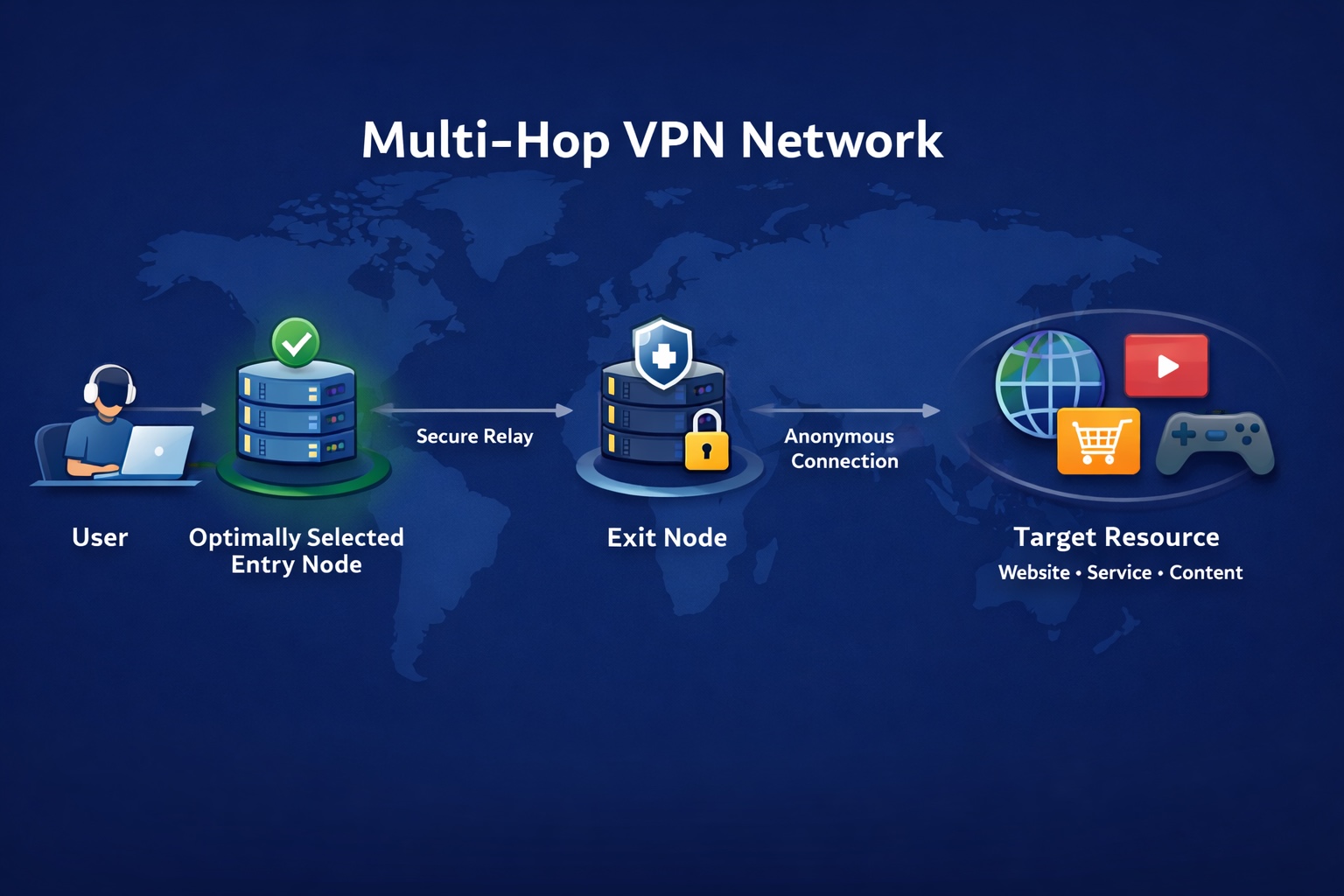
The system automatically selects the optimal node path based on network quality, for example:
User → Optimally Selected Entry Node → Exit Node → Target Resource
Compared to traditional single-node VPNs, this multi-hop path can:
- Avoid congested international lines
- Optimize cross-border network routing
- Enhance connection stability
In complex network environments, this architecture can significantly improve:
- Network latency
- Packet loss rate
- Long-term connection stability
For users needing stable cross-border access, this intelligent routing mechanism can significantly enhance the overall network experience.
Differences Between Multi-Hop VPN and Regular VPN
| Feature | Single-Node VPN | Multi-Hop VPN |
|---|---|---|
| Network Latency | Lower | Slightly Higher |
| Connection Stability | Average | Higher |
| Routing Optimization Capability | Limited | More Flexible |
| Privacy Protection | Good | Stronger |
Although Multi-Hop VPNs may introduce a slight increase in latency in some cases, they often provide a more stable and reliable connection experience in complex network environments or cross-border connections.
When is it Suitable to Use Multi-Hop VPN?
Multi-Hop VPNs are particularly suitable for the following scenarios:
- Cross-border network access
- Unstable international network environments
- High privacy protection requirements
- Need for long-term stable connections
For example:
- Remote work
- Cross-border e-commerce
- Accessing overseas business
- Data transmission and remote management
In these scenarios, Multi-Hop VPNs can effectively improve network stability and reliability.
Conclusion
The VPN experience depends not only on server location or bandwidth but more importantly on overall network quality and routing optimization capability.
Latency, packet loss rate, and network paths directly affect the stability of VPN connections.
Through Multi-Hop VPN technology, data transmission paths can be optimized in complex network environments, thus enhancing the stability and security of the VPN.
For users needing stable cross-border network connections, Multi-Hop VPN is becoming an increasingly important technology.