Telegram founder Pavel Durov described the banking chaos as a “massive banking failure” and pointed out that 65 million Russians still use Telegram every day — through VPNs. He’s now urging those users to stock up on backup tools while access is still possible.
This article breaks down how Russia’s internet censorship system works, how the VPN crackdown has escalated step by step up to today, and what ordinary users — inside Russia and beyond — can do to protect their access.
What Is Russia’s VPN Ban — and When Did It Start?
Russia’s campaign against VPNs began in 2017, when the government passed legislation banning the use of VPNs, proxies, and anonymizing tools to access blocked websites. In theory, the law was straightforward: if a website is banned, tools that bypass that ban should be banned too.
In practice, enforcement was nearly nonexistent for two years. Russia’s technical infrastructure simply wasn’t capable of detecting and blocking VPN traffic at scale.
That changed in 2019, when Russia’s Sovereign Internet Law took effect. The law gave the government authority to disconnect Russia’s internet from the global web if needed, and required every internet service provider (ISP) to install state-controlled deep packet inspection equipment — known as TSPU. These devices, distributed and managed by regulators, sit at key network backbone points and analyze internet traffic in real time.
As Mediazona detailed in a 2026 report, TSPU operates alongside SORM — a surveillance system that requires telecoms to store years of communications data and hand it to the FSB on demand. Together, they form the infrastructure of what Russia calls RuNet: a national internet the government can monitor and control independently of the global web.
How the Ukraine War Accelerated Russia’s Internet Censorship
February 2022 was the turning point. Within weeks of the invasion of Ukraine, Facebook, Instagram, and Twitter were blocked inside Russia. Independent news outlets went dark. Tens of millions of Russians, suddenly cut off from platforms they used every day, flooded app stores looking for VPNs — downloads hit record highs almost overnight.
For Russian authorities, that response exposed a critical flaw in the censorship strategy. The blocked platforms were still reachable. The information firewall had a hole in it, and that hole was called a VPN.
So the focus shifted. Roskomnadzor — Russia’s internet watchdog — pressured Apple and Google to remove non-compliant VPN apps from their Russian storefronts. By 2024, dozens of major services had been pulled, including NordVPN, ProtonVPN, and PIA VPN. Advertising VPNs became illegal, with steep fines for anyone promoting them. The goal was not just to block VPN tools — it was to make them hard to find, hard to buy, and eventually impossible to use.
How Russia Blocks VPNs: Three Escalating Phases
Understanding how Russia’s VPN blocking has evolved explains both why it keeps failing — and why each new phase causes more collateral damage than the last.
Phase 1 — Blocking IP addresses. Early efforts blacklisted the IP addresses of known VPN servers. VPN providers responded by rotating servers constantly. It became a game of whack-a-mole that regulators couldn’t win.
Phase 2 — Blocking protocols. TSPU hardware shifted to protocol-level detection — analyzing the behavioral fingerprints of VPN traffic rather than fixed addresses. By late 2025, Russia had blocked three of the most widely used VPN protocols, including VLESS, a protocol specifically engineered to evade censorship detection. According to Human Rights Watch’s March 2026 report, 469 VPN services had been blocked by February 2026.
Phase 3 — Blocking users. In March 2026, Russia took the crackdown to a new level. According to a Meduza exclusive report, Digital Development Minister Maksut Shadayev held a private meeting with more than 20 major tech companies on March 30. The directive: detect and block any user connecting via VPN by April 15, or lose eligibility for the government’s “whitelist.” Platforms were handed a technical manual describing a two-step detection method — first comparing user IPs against databases of blocked addresses, then running a second check through the platform’s own app to determine whether traffic was being selectively routed through a VPN. They were also told to report newly identified VPN services back to regulators to expand the master blocklist.
Shadayev publicly acknowledged the political heat the measures generated, calling them “a difficult compromise.” Officials had debated making VPN use a criminal offense, he said — but ruled it out as “a blunt solution we categorically dislike.”
According to anonymous sources in Russia’s IT and telecoms industry speaking to independent outlet The Bell, the driving force behind all three phases is a special FSB unit — the same one previously accused of involvement in the poisoning of opposition activist Alexei Navalny. The Kremlin has not confirmed this.
April 4 to April 15: From Banking Collapse to Blanket Blocks
The new filtering rules went live in early April — and within days, they had broken something far more important than anyone intended.
On April 4, Roskomnadzor’s VPN-blocking systems swept encrypted traffic — and caught banking data streams in the same net. Payment apps stopped working nationwide. Moscow metro turnstiles swung open without scanning. Shops and restaurants reverted to cash. Heise Online reported that Russian authorities declined to comment.
Durov, watching from abroad, posted his verdict on Telegram — later picked up by Bloomberg: the government had spent years trying to ban Telegram, yet 65 million Russians still use it daily via VPNs. “Their blocking attempts just triggered a massive banking failure — cash briefly became the only payment method nationwide.” He drew a comparison to Iran, where banning Telegram didn’t produce mass adoption of state apps — it produced mass adoption of VPNs. “Now 50 million members of the Digital Resistance in Iran are joined by 50 million more in Russia.”
Despite the chaos, the April 15 deadline held. The Moscow Times reported that banks, video streaming services, online retailers, and search engines all began blocking access for users with active VPNs. AFP journalists in Moscow confirmed the blocks firsthand, receiving error messages on Ozon and Wildberries reading “access denied — turn off VPN connection if you are using one.” Gosuslugi, Russia’s government services portal — used by citizens for everything from tax filings to passport renewals — was also blocking VPN users.
In a further sign of how thoroughly the Kremlin wants to close information gaps, Roskomnadzor banned “VPN Traffic Light” on April 9 — a volunteer-run website launched in March 2026 by blogger and politician Maxim Katz that tracked which VPN services were still working inside Russia. Blocking a site whose only purpose was to tell people which tools still worked is, in its own way, a revealing move.
Then, on April 17, came the next escalation. Meduza reported that Russian authorities are now seeking to ban hosting providers from supplying server capacity to any operator giving access to blocked content. This goes beyond blocking apps or users — it targets the servers that VPN services actually run on. If implemented, it would be the most structurally damaging measure yet.
How Russia’s VPN Crackdown Affects Ordinary People
The policy picture is complicated. The human reality is simpler: life inside Russia’s internet is getting harder, and it’s affecting people who have nothing to do with politics.
Access to independent information is shrinking fast. BBC News, Deutsche Welle, and dozens of independent Russian-language news outlets are blocked without circumvention tools. The total number of blacklisted websites in Russia has now reached 4.7 million. As The Moscow Times reported, one Moscow resident said she needed a VPN running just to speak with a journalist. “You’d better ask how this is affecting my nerves.”
Everyday services now demand you drop your VPN. After April 15, using a VPN doesn’t just slow down your connection — it locks you out of shopping, banking, government services, and streaming. The choice Russians face is increasingly stark: stay protected and lose access, or go unprotected to get things done.
Professional tools are becoming unreliable. GitHub, Google Workspace, Notion, Slack — services that developers, designers, and remote workers rely on — are increasingly unstable or inaccessible from inside Russia. Corporate VPNs have become standard, though they’re not immune to the filtering errors that caused the April 4 banking collapse. In February 2026, the FSB began demanding that banks install SORM surveillance equipment, and excluded non-compliant institutions from the government whitelist.
Paying for foreign services is increasingly difficult. Visa and Mastercard left Russia in 2022. In April 2026, Apple blocked mobile billing as an App Store payment method — one of the last ways Russians could subscribe to foreign services, including VPNs. Authorities are also pushing mobile operators to charge extra for international data consumption exceeding 15GB per month before May — a direct financial penalty targeting VPN users. As one analyst told The Moscow Times: “The internet is becoming something only the wealthy can afford.”
The state-approved alternative raises serious privacy concerns. MAX, a government-backed messaging app modeled after China’s WeChat, has been pre-installed on phones and mandated in schools and government offices. According to Human Rights Watch, security researchers found MAX sending repeated requests to WhatsApp and Telegram domains from users’ devices — and flagged the possibility it scans for active VPN connections. MAX has denied the claims.
Legal risk is growing. Since September 2025, Russian users can be fined for intentionally searching for “extremist” content online — including via VPN. VPN use has appeared as an aggravating factor in criminal cases. The boundaries are deliberately vague, which creates a chilling effect: people self-censor not because they know something is prohibited, but because they’re not sure it isn’t.
How to Bypass VPN Restrictions: What Actually Works Right Now
The crackdown is serious, but users aren’t without options. Here’s what actually makes a difference — based on what’s happening on the ground today.
Install a VPN now, not when you need it. Once an app is pulled from a store or blocked at the network level, finding a replacement is genuinely difficult. The window is open right now — don’t wait until it closes. Durov himself has been urging Russians to “stock up on several VPNs” while access is still possible.
Prioritize VPNs with obfuscation support. Standard VPN protocols leave recognizable traffic signatures that Russia’s deep packet inspection systems are trained to detect. A VPN with obfuscation — also called stealth mode or traffic masking — disguises its traffic as ordinary HTTPS browsing. VPN providers like Windscribe have already launched dedicated stealth apps designed specifically to maintain connectivity under Russia’s current blocking regime. In a country actively blocking VPN protocols at the infrastructure level, obfuscation support is the single most important feature to look for.
Don’t use Russian apps while connected to a VPN. This is a newer and important warning: platforms are now required to report newly detected VPN services back to Roskomnadzor. Using Russian apps while on a VPN may expose your VPN’s fingerprint to the blocklist. Keep Russian services and VPN usage separate where possible.
Configure your VPN at the router level. ISP-level detection targets individual devices. Setting up a VPN on your home router encrypts all outgoing traffic before it reaches your ISP — raising the bar for detection considerably, and covering every device on your network automatically.
Have a backup VPN ready. Any service can be blocked without warning. Keeping a second option installed and tested means you can switch immediately rather than scrambling when your primary tool goes down.
Update your VPN client regularly. Providers push new configurations and protocol updates in direct response to new blocking measures. A simple app update is often all it takes to restore connectivity after a new crackdown wave.
Frequently Asked Questions About Russia’s VPN Ban
Is using a VPN illegal in Russia?
VPN use is not explicitly criminalized in Russia, but it exists in an increasingly hostile legal grey zone. Advertising VPNs is illegal. Using a VPN to access banned content can be treated as an aggravating factor in legal proceedings. Since September 2025, deliberately searching for “extremist” content via VPN can result in fines. Authorities have repeatedly said a full blanket ban is not planned — but the practical space for VPN use is narrowing steadily with each new phase of enforcement.
How many VPN services has Russia blocked?
As of February 2026, Roskomnadzor had confirmed the blocking of 469 VPN services, according to Human Rights Watch. Three widely used VPN protocols have also been blocked since December 2025. The total number of blocked websites in Russia now stands at 4.7 million.
Can VPNs still work in Russia?
Some can — but the window is narrowing. VPNs with obfuscation technology that disguises traffic as regular web browsing have a significantly better track record in Russia’s current environment. Providers like Windscribe and AmneziaVPN are actively updating their tools to stay ahead of new detection methods. Standard VPN protocols are increasingly detectable. The landscape changes fast — choosing a provider that actively updates its infrastructure is essential.
Why did Russia’s VPN block crash the banking system?
The deep packet inspection systems Roskomnadzor deployed to block encrypted VPN traffic also caught banking app data streams — which use similar encryption. The result was a nationwide payment outage on April 4, 2026. Moscow metro gates opened freely. Shops went cash-only. Russian authorities declined to comment. It wasn’t the first such incident — earlier filtering errors had disrupted bank-specific VPNs — but it was the largest and most public.
What happened after Russia’s April 15 VPN deadline?
Major Russian platforms — including Ozon and Wildberries (two of the country’s largest e-commerce sites), streaming services, banks, and the government’s own Gosuslugi portal — began blocking users with active VPNs. AFP journalists in Moscow confirmed the error messages firsthand. Separately, Russia moved to ban hosting providers from supplying server capacity to VPN operators, targeting the infrastructure layer directly. A volunteer website tracking which VPNs still worked in Russia was itself blocked on April 9.
What is Russia’s “sovereign internet” (RuNet)?
RuNet refers to Russia’s long-term project to build a national internet capable of operating independently from the global web. Enabled by the 2019 Sovereign Internet Law, it gives the government the infrastructure to reroute, throttle, or cut off international traffic entirely. The country has conducted live “disconnection tests” in remote regions to verify the system works. The FSB surveillance system SORM runs alongside RuNet’s filtering infrastructure, requiring telecoms to store and hand over communications data on demand.
Why Obfuscation Is Now Non-Negotiable — and How Surflare Delivers It
If there’s one lesson from Russia’s crackdown, it’s this: not all VPNs are equal. Standard VPN protocols are now blocked at the infrastructure level. The VPNs that are still working inside Russia share one common feature — obfuscation: the ability to disguise VPN traffic as ordinary web browsing. It’s no longer a premium extra. It’s the baseline.
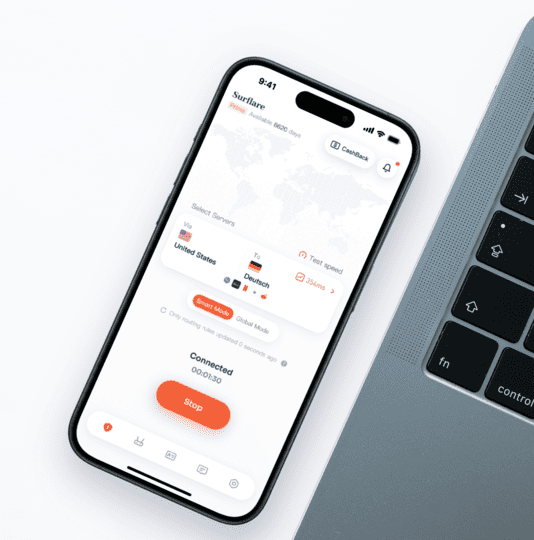
Surflare VPN is built around exactly that principle. Surflare’s obfuscation technology masks your connection so it’s indistinguishable from regular HTTPS browsing — making it significantly harder for deep packet inspection systems like Russia’s TSPU to detect and block. A strict zero-log policy means nothing you do online is ever recorded or shared. And with apps across all major platforms, getting protected takes minutes, not a degree in networking.
Russia’s internet is becoming a closed system. That process is underway in other countries too — quietly, incrementally, until one day the tools people relied on are simply gone. The time to have a reliable VPN in place is before you need it.
👉 Visit surflare.com and get protected today
This article draws on reporting from Bloomberg, The Moscow Times, Meduza, Human Rights Watch, Mediazona, Heise Online, and TechRadar. For informational purposes only. VPN legality varies by jurisdiction — check local regulations before use.
Sivor Veyron