When discussing VPNs in Singapore, many people mistakenly believe it is a "niche" or "sensitive" topic. The reality is that Singapore has excellent internet infrastructure, frequent cross-border connections, high public network usage, and highly digitalized online services—these factors make VPNs more like a "tool for enhancing online experience and risk control," rather than something for special purposes.
This article will clarify the real problems that "Singapore VPN" addresses from practical scenarios, and then use a set of measurable and comparable standards to help you understand four common choices: NordVPN, Surfshark, Proton VPN, and Surflare VPN. Finally, simple and straightforward selection advice will be provided, along with answers to common questions.
What Problems Does "Singapore VPN" Actually Solve?
The term "Singapore VPN" actually corresponds to two completely different needs. If not clarified from the beginning, it is easy to be misled by advertising terms like "number of nodes," "global coverage," and "military-grade encryption" when making a purchase.
- The first need is: users located in Singapore need a VPN to achieve better privacy, connection stability, and cross-region content experience.
These users typically do not lack "internet speed," as the local network in Singapore is already very fast. The real issues you will encounter are more about wanting a more stable encrypted connection in complex network environments like airports/hotels/cafes; not wanting to frequently disconnect when switching between different networks (Wi-Fi ↔ mobile network); not wanting to be slowed down by poor cross-border routing when accessing overseas services; or hoping that "what should go through VPN does, and what shouldn't connects directly," making daily use more worry-free. - The second need is: users not in Singapore but need a Singapore IP to access content or services that are only available to Singapore.
These users are not primarily concerned with "how many global servers there are," but rather: whether the Singapore node is stable and usable, whether the IP is easily identified as a proxy by platforms, whether it frequently triggers SMS verification/captcha, and whether it can remain usable for a long time. In other words, this type of need places more emphasis on "the quality of the Singapore node and IP reputation," rather than how long the feature list is.
The evaluation focus for these two types of needs is different. You can understand it in one sentence: For those in Singapore, choosing a VPN is more about "experience and stability"; for those not in Singapore, choosing a VPN is more about "the availability of Singapore IP and risk control for identification."
Who Uses VPNs in Singapore? Common Scenarios Are Just a Few Types
In Singapore, VPNs are not a niche tool; they often demonstrate their value in specific use cases. From actual usage, common needs mainly focus on the following categories.
Scenario 1 | Cross-Region Content and Account Experience
Singapore is a typical international content consumption market, but this also means that content and account experience highly depend on regional judgment. Many users encounter similar situations: the content libraries of the same platform are not consistent across different regions; certain sports events, live broadcasts, variety shows, or films cannot be played in Singapore; some e-commerce pages, membership benefits, or price displays change due to different regions; even the same account may be prompted with "content unavailable" or "this region is not supported" when logged in from different countries, or may require additional verification. Common examples include:
On Netflix, Disney+, and Amazon Prime Video, the differences in available film and television content across different countries are significant; some sports events (such as soccer, F1, NBA broadcasts with regional copyright restrictions) may not be directly viewable in Singapore; on YouTube and Twitch, some channels or live broadcasts may be restricted due to regional copyright issues; certain overseas e-commerce or subscription services display different prices and promotional information in different regions.
In this scenario, the value of a VPN is not about "whether it can open the website," but rather two more practical matters.
- First, whether unlocking is stable.
Being able to access once does not mean a good experience; what truly affects the user experience is: whether it frequently fails during continuous use, whether it requires repeated node switching, and whether it suddenly cannot play during peak hours.
- Second, whether it easily triggers platform risk control.
If you frequently encounter captcha or re-login prompts during viewing, or even temporary account restrictions, then even if "theoretically it can unlock," the actual experience will be very poor.
Therefore, for these users, a more reasonable evaluation standard for a VPN should be: unlock stability + infrequent triggering of verification or risk control + connection quality that can stably support high-definition video playback. Simply emphasizing "large bandwidth" does not equate to "smooth video watching"; the more critical factors are still latency, jitter, node congestion, and overall line stability.
Scenario 2 | Daily Security and Privacy on Public Wi-Fi
Singapore has extensive public network coverage: airports, hotels, shopping malls, cafes, and co-working spaces are very common. Public Wi-Fi does not equal "unsafe," but its risk structure is different from home networks: network managers may not be trustworthy, hotspots may be spoofed, and there are more and more complex devices on the same local area network. For ordinary users, you do not need to become a security expert, but you need a "default more secure" connection method.
In this scenario, what really matters is not "how many features," but rather:
- One-click connection stability: you do not want to fiddle with settings every time you open your computer.
- Reliable automatic reconnection: if the network fluctuates slightly, you do not want to disconnect immediately and get stuck.
- Smooth switching between mobile networks: when switching from Wi-Fi to 5G, the connection should smoothly recover.
In other words, this type of demand is essentially about "peace of mind." Here, a VPN is more like a tool that "defaults to encrypting the connection and reducing exposure," rather than pursuing some extreme effect.
Scenario 3 | Cross-Border Work and Remote Collaboration
Singapore has a large number of multinational companies, remote workers, and cross-border collaboration scenarios. You may use various overseas SaaS and collaboration tools: Google Workspace, Slack, Notion, GitHub, Zoom, Dropbox, etc. In most cases, they can be accessed normally in Singapore, but you will encounter another more practical issue: stability and path quality.
For example: during meetings, you care more about latency and jitter; during uploads and downloads, you care more about sustained throughput; when accessing specific regional resources, you care more about whether the connection is smooth. Many people find that the same service can have vastly different experiences at different times or under different networks. At this time, the value of a VPN is to provide a more controllable and stable "alternative path."
Moreover, this scenario is very suitable for using application-based/smart routing:
You can let "meetings, banking, local services" connect directly to reduce latency; let "overseas collaboration, specific sites, cross-border access" go through VPN to enhance stability or accessibility. This approach usually achieves a better balance between "global VPN" and daily real needs: it does not sacrifice local speed while providing a more stable cross-border experience when needed.
In actual products, this capability usually appears in the form of "application-based smart routing." For example, Surflare's smart routing distinguishes traffic based on the application layer to balance stability and local access experience in cross-border collaboration scenarios.
Scenario 4 | Gaming and Low Latency Needs
For gamers, the key to network experience is not about "how fast the download speed is," but rather latency, jitter, and packet loss rate, as well as whether the connection remains stable during peak hours. Especially when connecting across regions or to overseas servers, these metrics often more directly affect the feel of operations and combat experience than bandwidth size.
Many players encounter similar situations: the network performs well during speed tests, but there are skill delays, screen freezes, or even teleportation in games; the experience is acceptable during the day, but latency fluctuations significantly increase at night or on weekends. These issues are usually not due to insufficient speed, but rather suboptimal routing paths or congestion during peak times.
In such cases, a VPN can sometimes adjust the network path to avoid some congested nodes, making the connection smoother and latency more stable. However, it is important to note that this is not a guaranteed result—if the node selection is inappropriate, or if the VPN itself is too congested during peak times, it may actually worsen latency and jitter.
Therefore, when evaluating a VPN in gaming scenarios, the focus should be on the following points: whether latency is stable rather than the lowest value, whether jitter is controllable, whether performance during peak hours is reliable, and whether there are obvious detours in cross-region paths. Simply emphasizing "high-speed bandwidth" has limited reference value for gamers.
A more realistic approach is to view gaming scenarios as a "pursuit of stability rather than extreme speed". If you are very sensitive to operational latency or frequently engage in cross-region connections, then during the trial of the VPN, conducting actual gaming tests over several days during your usual time slots often provides more meaningful reference than any speed test results.
Scenario 5 | People Who Need a "Singapore IP" (Located Overseas)
This demand is very clear: you need a Singapore region IP to access local services, media content, region-restricted pages, or application features that are only available to Singapore. The real challenge is not "whether it can connect," but rather whether it can be used long-term, stably, and without frequent restrictions.
As platforms become increasingly strict in identifying proxy traffic, when the same IP is shared by many users, it is more likely to trigger SMS verification, captcha, or even direct access restrictions. This is also a situation many users encounter: usable for a short time, but quickly becomes unstable. Therefore, the core evaluation criteria for this type of demand usually focus on three points:
- Whether the Singapore node is long-term usable, rather than just "as long as it's available";
- The reputation and stability of the IP, whether it is easily identified as a proxy, and whether it frequently triggers verification;
- Sustainable usability, whether it remains usable after a period of time, rather than constantly changing solutions.
It is important to note that not all "Singapore IPs" are viewed the same way by platforms. When using heavily shared non-pure IPs, their proxy characteristics become apparent, which is the root cause of frequent risk control.
Based on this difference, some VPN services offer more targeted IP solutions, such as:
-
Dedicated IP: used by a single user, the IP behavior is more stable and less likely to trigger platform risk control due to "neighboring users." Among them, Residential IP is closer to the characteristics of a real home network environment and is usually less likely to be directly marked as a proxy than ordinary shared nodes.
It should be emphasized that this is not an option that everyone must consider. For users who only occasionally access Singapore content or services, stable ordinary Singapore nodes are often sufficient; only when you rely on Singapore IP long-term and frequently encounter verification or restriction issues is it necessary to further consider such more specialized IP solutions.
If you have clearly identified yourself as belonging to this type of demand, Surflare offers a Dedicated IP product for Singapore, which can be viewed on the official website for further reference. (Surflare Dedicated IP)
6 Hard Criteria for Choosing a Singapore VPN
Many articles will list a bunch of "encryption algorithms, military standards, no logs, Kill Switch," which sound powerful, but it's hard to judge what they actually mean for you. A more reliable approach is to break down "usability" into several perceivable and comparable indicators.
1) Quality of Singapore Nodes (Not Quantity)
While the number of nodes is certainly important, in the Singapore context, "quality" often determines the experience more than "quantity." You need to pay attention to:
- Whether there is congestion during peak hours and whether there is a noticeable drop in speed;
- Whether disconnections are frequent or require repeated reconnections;
- Whether it easily triggers platform verification (especially in scenarios where you need a Singapore IP).
If a VPN advertises many Singapore nodes but frequently disconnects, significantly slows down during peak hours, or requires repeated switching to connect, then these "numbers" hold little practical significance for users.
Especially when you need a Singapore IP to access specific content or services, node quality directly affects whether it triggers platform verification and whether it is identified as proxy traffic. Stable, not overly congested, and sustainably usable nodes are far more important than "having many nodes."
2) Speed Experience Should Focus on "Latency/Jitter/Loss," Not Just Bandwidth
The local network in Singapore is already very fast, so many VPNs can show impressive bandwidth numbers on speed test websites. However, in real usage experience, what determines whether you feel "smooth" is not peak download speed, but rather the following three factors:
- Whether latency is stable, which affects the smoothness of web responses and real-time operations;
- Whether jitter is significant, which affects whether videos, voice, and meetings experience fluctuations;
- Packet loss situation, which determines whether the connection experiences stuttering, retransmission, or brief interruptions.
This is why some VPNs seem fast during speed tests but feel "uncomfortable" when watching videos, attending meetings, or using for extended periods. In Singapore's high-speed network environment, stability is often more important than extreme speed.
3) Protocol and Connection Capabilities (Determine Whether You Can Be Worry-Free)
Ordinary users do not need to study the technical details of protocols, but they can definitely feel "whether the connection is fast and stable." A mature VPN product should perform reliably in the following aspects:
- Whether the connection establishment is quick;
- Whether it can automatically recover during slight network fluctuations;
- Whether it requires manual reconnection when switching between Wi-Fi and mobile networks.
These capabilities may seem inconspicuous, but they directly determine whether your daily use of the VPN is "seamless" or "frequently interrupted." Especially when going out, traveling, or frequently switching network environments, this difference will be amplified.
4) Application-Based/Smart Routing Capabilities (Significantly Impact Daily Experience)
Many users initially choose to "turn on VPN globally," but in Singapore's network environment, this is often not the optimal solution. The reality is: you do not need all applications to go through the VPN.
You may want:
- Banking, local delivery, ride-hailing, and payment applications to maintain direct connections;
- Overseas collaboration tools, specific content platforms, and cross-border access to go through VPN;
- Some applications may even require fixed regional nodes, while others do not.
If the VPN supports application-based routing or more refined policy control, you can achieve a more reasonable balance between speed, stability, and compatibility, rather than repeatedly toggling the VPN on and off or enduring unnecessary performance losses.
5) Privacy and Logging Policy (Look for Clarity and Executability)
"No logs" is a common slogan, but what you should look at is not the slogan itself, but whether its privacy policy is clear, boundaries are defined, and unnecessary data retention is minimized at the product level. For ordinary users, the conclusion is very pragmatic: the clearer the privacy policy is written, with fewer vague commitments, the more trustworthy it is.
6) Multi-Platform Support and Router Solutions (Determine Whether "One Solution Can Cover All")
In real life, a VPN rarely serves only one device. Phones, computers, tablets, TVs, and game consoles often coexist.
If the VPN provides mature multi-platform support or relatively easy-to-use router solutions, it means you can cover more devices with one configuration, reduce maintenance costs, and it is more suitable for families or long-term use. This "peace of mind" often becomes apparent only after a period of use.
Best 4 Singapore VPNs for 2026
If you just want to get a "direction" first, you can use the following four as preliminary filters. They are not absolute conclusions but are quick categorizations based on product positioning and typical usage preferences.
-
NordVPN
Suitable for users who want to "make one choice that covers most scenarios," overall mature and worry-free.
If the needs are mainly focused on Singapore or Southeast Asia, its global configuration may not be fully utilized.
-
Surfshark
Suitable for users with many devices, budget-sensitive, and needing family sharing, with outstanding cost-effectiveness.
When there are high requirements for node stability, it is recommended to focus on testing commonly used regions during the trial period.
-
Proton VPN
Suitable for users who prioritize privacy and security trust, with a very clear ideological orientation.
It is not aggressive in terms of price and flexibility, more like a choice of "paying for trust."
-
Surflare VPN
Suitable as a high-quality alternative outside of major brands, focusing on connection stability in Singapore and Southeast Asia.
Enterprise-level line quality and application-based smart routing are more suitable for users who care about long-term smooth experiences.
In-Depth Comparison: Performance and Positioning of Four VPNs in Actual Use
NordVPN: A Worry-Free General Choice
NordVPN is headquartered in Panama and is widely regarded as a "universal service for all scenarios" due to its extensive coverage. It has thousands of server nodes in over 100 countries, which means that when accessing cross-region content, unlocking streaming media, and accessing region-specific services, users often have more optional paths, thereby reducing the probability of access failure caused by congestion of a single regional node.
The advantage of NordVPN does not lie in any extreme metric, but in the overall balance of the experience. In cross-region content access, daily privacy protection, travel use, and occasional cross-border work scenarios, it can usually provide a relatively stable and predictable experience, rarely requiring users to repeatedly adjust settings or frequently switch nodes. This characteristic of "wide coverage + many backup paths" is particularly evident when you frequently switch between different regional nodes, ensuring basic usability in most situations.
In terms of protocol support, NordVPN generally supports OpenVPN and WireGuard (NordLynx), performing relatively well in connection establishment speed, path stability, and mobile network switching experience. Coupled with a large number of nodes and a mature brand, the probability of triggering verification or being identified as a proxy when accessing cross-border services such as Netflix (US/UK), Disney+, Amazon Prime Video, etc., is usually lower than many services with smaller node scales and higher sharing degrees.
It is also important to note that this "comprehensive coverage" orientation means it is not deeply optimized for any specific region or usage scenario. If your main usage needs are highly concentrated in Singapore or Southeast Asia, or if you have very clear preferences for a certain type of experience (such as long-term stability or more refined routing strategies), then its global configuration may not match your actual needs closely.
Furthermore, broad coverage and a complete functional system often come with prices in the mid-to-high range, as well as some features that certain users may not utilize in actual use. These factors will ultimately reflect in the package pricing, making it more suitable for users who want to "make one choice that covers most scenarios," rather than those pursuing extreme targeted optimization.
Surfshark: "Cost-Effective + Multi-Device" Choice
Surfshark has a very clear positioning: to cover more devices and a wider range of daily usage scenarios at a friendlier cost. It is headquartered in Amsterdam, Netherlands, and its most prominent feature is supporting unlimited device connections, making "one subscription covering phones, computers, tablets, and family members' devices" a very intuitive and attractive value point.
In terms of network scale, Surfshark covers over 60 countries globally, with a sufficient number of nodes and coverage breadth to meet most daily privacy protection and cross-region content access needs. For usage scenarios focused on content consumption, basic encrypted connections, and family sharing, its overall configuration is complete and user-friendly, avoiding the extra costs associated with multi-device licenses.
However, it should be clarified that Surfshark's cost-effectiveness advantage essentially comes from "broad coverage," not "deep optimization." In some scenarios with higher connection quality requirements—such as cross-border access during peak hours, reliance on long-term stability of specific regional nodes, or the need for consistently low fluctuation connections—its experience is more easily affected by the specific node load. This means that when the usage environment becomes more "demanding," performance may not be as stable as those services that invest more in line optimization and resource control in specific regions.
Therefore, Surfshark is more suitable for users with relatively clear needs, daily usage scenarios, and a desire to control costs. If your core demand is "many devices, wide usage, and not too expensive," its advantages are very direct; but if you care more about whether it remains stable during peak hours, whether it minimizes hassle, and whether certain regions perform consistently over the long term, then it is still necessary to focus on verifying the actual performance of your most commonly used regions and time slots during the trial phase before making a final decision.
Proton VPN: "Privacy Trust First" Choice
Proton VPN is operated by Proton AG, based in Switzerland. This jurisdiction is generally friendly to privacy protection, and the Proton series of products have long emphasized security and transparency, which extends to the privacy policy and logging architecture of the VPN. Compared to simply emphasizing speed or coverage scale, Proton VPN highlights its expression of privacy commitments and technical implementation, such as clear privacy policy terms and product design that minimizes logs.
In terms of network scale, Proton VPN's servers cover dozens of countries, with hundreds of nodes sufficient to support daily encrypted connections, basic cross-region access, and regular content usage. Functionally, it can accomplish the core tasks of an ordinary VPN, but its true differentiator lies not in the number of nodes or unlocking capabilities, but in making privacy protection the primary design goal. This orientation is reflected in actual use by minimizing the retention of user activity data, reducing the risk of metadata exposure, and providing a more secure choice for users who wish to obtain a higher security boundary in uncertain network environments.
For this reason, Proton VPN typically attracts those with clear preferences for privacy and security philosophies. Choosing it essentially represents a trade-off: when you prioritize privacy trust, it often means being willing to pay a higher cost for stricter privacy governance and consistent security philosophy, or accepting differences in experience in certain usage scenarios.
This does not mean that Proton VPN performs poorly in other aspects, but rather that its purchasing rationale leans more towards "value-driven." If your core demand is to keep costs low, maximize the number of devices, or pursue optimal solutions for streaming media unlocking and node coverage, it may not be the most direct choice; but if you value the credibility of privacy commitments, consistency in security product lines, and trust during long-term use, its positioning will be very clear.
Surflare VPN: A Wise Choice Focused on Stability and Connection Experience
Surflare VPN is headquartered in Singapore, and its positioning does not revolve around the number of features or global coverage scale, but rather emphasizes the stability and consistency of connections in real usage environments. Compared to pursuing an all-encompassing product that "can do everything," it focuses on a more specific question: whether the connection can remain available and the experience smooth under network fluctuations, peak times, or complex network conditions.
This orientation is first reflected in its self-developed high-anonymity protocol. The core value of this protocol lies in improving connection availability in fluctuating network environments. In scenarios like airports, hotels, or public Wi-Fi, there are fewer occurrences of "already connected but frequently dropping speed or disconnecting," and this difference is usually more perceptible during continuous use or peak times.
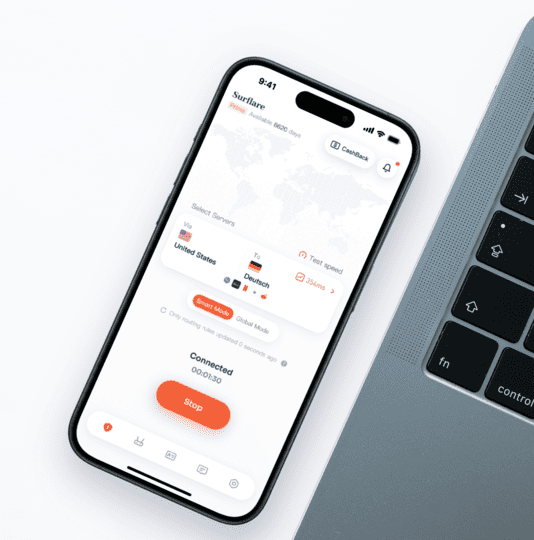
Surflare also supports application-based per-application smart routing. It does not require all traffic to go through the VPN but allows for path differentiation based on application needs: applications requiring cross-border access go through the VPN, while local services maintain direct connections. In actual experience, local application compatibility is better, cross-border access is more stable, and it reduces the operational costs of frequently toggling the VPN on and off or switching modes.
In terms of nodes and line strategies, Surflare focuses more on the connection quality towards Singapore and Southeast Asia rather than simply expanding the number of nodes. For users whose usage scenarios are mainly concentrated in Singapore and surrounding areas, this orientation is more likely to be reflected in whether there is significant degradation during peak times and whether the overall connection remains predictable.
Additionally, Surflare is relatively restrained in bandwidth allocation and user scale control, avoiding the impact on peak experience due to excessive resource sharing. This strategy may not be prominent, but it helps maintain a more consistent connection performance over long-term use.
On the decision-making level, Surflare offers free trials with no speed or flow limits, allowing users to directly verify the experience in real usage scenarios without relying on parameters or promotional descriptions. For users with higher IP quality demands, Surflare also provides a Dedicated IP solution as a supplementary choice for specific purposes. Additionally, its VPN for Teams product can meet small-scale collaboration scenarios, but this is not the focus of this article.
Overall, Surflare VPN is more suitable as a high-quality alternative outside of mainstream big brands with a clear orientation. If your focus is not on how many countries are covered but on whether the connection is stable, smooth, and whether it is worry-free enough in high-frequency usage scenarios, its advantages will be more direct.
How to Choose Without Hesitation
After reviewing the indicators and positioning, the truly effective approach is not to repeatedly compare parameters, but to first clarify your own usage priorities. The following four judgments can directly narrow the selection range to one.
-
If you want one solution to cover most usage scenarios and minimize the hassle of settings and details, prioritize the overall balanced and mature NordVPN.
-
If you have many devices and family sharing is a must, while being budget-sensitive, you can prioritize Surfshark, but it is recommended to focus on testing performance during peak hours and commonly used regional nodes during the trial period.
-
If you value long-term privacy trust and security philosophy, rather than just the functionality itself, then Proton VPN aligns more with this orientation.
-
If you mainly use Singapore and Southeast Asia, hope to maintain relative stability during peak hours, and value the daily experience brought by application-based routing, then Surflare VPN is worth prioritizing.
The key is not "which VPN is the best," but rather which one best fits your usage style. Once the judgment logic is clear, the choice itself becomes simple, and there is no need to waver between different products.
Usage Suggestions for Singapore VPN
Many issues of "VPN not working well" are not due to the product itself but rather mismatched usage methods. The following suggestions are very basic but sufficient to solve 80% of experience problems.
First, node selection should follow the "proximity first, goal-oriented" principle.
If you are in Singapore, most of the time choose Singapore nodes first; if you are trying to access content from a specific region, then select the target region node; if congestion is obvious during peak hours, do not force it; switching to another node in the same city is often more effective than switching nodes across countries.
Second, replace the "global switch" with a routing mindset.
If your VPN supports application-based routing, keep "banking/payment/local services/ride-hailing" direct, and let "streaming media/overseas collaboration/specific sites" go through the VPN; you will encounter fewer compatibility issues and less frustration of "VPN slowing down" as a result.
Third, prioritize router solutions for multiple devices at home.
If you have many devices at home, a router solution can significantly reduce maintenance costs. You do not need to install clients on every device, nor do you need to fuss over every update. This is especially important for devices like TVs and game consoles where installing clients is inconvenient.
Fourth, treat the trial period as an evaluation period, testing just the two most important scenarios.
Do not test ten indicators at once; you will quickly become fatigued. The most practical approach is to select your two most commonly used scenarios, such as "watching videos during peak hours + stable connection on public Wi-Fi," and use them continuously for a few days to determine whether it is worth paying for.
FAQ
1) Is it legal to use VPNs in Singapore? What boundaries should be noted?
In Singapore, VPNs are generally regarded as a type of network tool. More importantly, the boundary of usage: using a VPN does not equate to obtaining the qualification to "evade the law." You just need to treat it as a tool for enhancing privacy and connection quality, avoiding using it for illegal activities. Ordinary users should pay attention to: comply with platform service terms and local laws, and not treat VPNs as a "universal key to do anything."
2) I live overseas; how can I obtain a Singapore IP? What is most important when choosing a VPN?
To obtain a Singapore IP, it essentially means connecting to a Singapore node of the VPN or purchasing a dedicated Singapore IP. The three most important factors to consider when choosing are:
- Whether the Singapore node is stable and usable (whether it frequently fails to connect or drops);
- Whether the IP easily triggers platform verification (shared congested nodes are more likely to trigger);
- Sustainability: whether it remains usable after a period of time, rather than "usable today but not tomorrow";
- Whether the IP address is clean and without sharing.
If you are accessing specific platform services, it is recommended to focus on testing the login, playback, or key functions of that platform during the trial period, rather than just looking at speed tests.
3) Why is it sometimes slower to connect to a VPN? What three things should I check first?
The three most common reasons are:
- Node congestion: especially during peak hours, many users on the same node will slow it down;
- Poor path: you selected an inappropriate regional node, leading to detours;
- Global proxy brings additional overhead: all traffic going through the VPN can slow down local services.
Recommended troubleshooting order: first switch to a node in the same city → then switch to a target regional node → then enable routing. In most cases, complex settings are not needed.
4) What to do if frequent verification/prompts for proxies occur while watching streaming media?
This is usually related to the "degree of sharing" of the node IP and the "platform risk control strategies." You can try the following in order:
- Switch to different nodes in the same region;
- Clear browser cache/re-login;
- Avoid frequently switching countries/nodes in a short time;
- Prioritize selecting nodes that have been stable in that region for a long time, rather than just clicking "fastest" each time.
5) Can free VPNs be used? How do they differ from "legitimate VPN free trials"?
Free VPNs and legitimate VPN free trials are not the same thing. Free VPNs often have issues with node congestion, unstable speeds, many functional and traffic limitations, and poor long-term usability, making them more suitable for temporary testing rather than continuous use.
In contrast, legitimate VPNs offering free trials are closer to a real experience verification period: typically allowing you to use lines and features close to the paid version, enabling you to determine whether it is truly usable in your network environment and usage scenarios.
For most users, being able to try it without sacrificing experience is far more valuable than "being free forever but with a poor experience."
6) Who is a router VPN suitable for? How do I determine if I need it?
If you meet any of the following criteria, it is worth considering a router solution:
- You have many devices at home and do not want to install clients on each one;
- You have devices like TVs/game consoles that are inconvenient to install VPN on;
- You want family members to use it more easily without needing to explain "how to turn on the VPN."
The value of a router solution is not in being "stronger," but in being "more worry-free and consistent."
7) Why is a VPN needed when traveling or working in Singapore?
When traveling or working, you are more likely to use public and temporary networks: Wi-Fi at airports, hotels, cafes, and conference venues may have instability or complex management issues. The main functions of a VPN are twofold:
- To encrypt the connection by default, reducing exposure of information in uncertain network environments;
- To make cross-border service connections more stable, especially when you need to continuously use overseas collaboration tools, email, cloud storage, and meeting services.
It is not "mandatory," but for many people, it is a "safer and more worry-free" choice, especially when you do not want to reassess risks in every network environment.
Unsure Which VPN is Right for You?
Parameters and promotions are hard to replace real usage experiences.
If you value whether the connection is stable, whether performance during peak hours is reliable, and the actual effects of application-based routing in daily use,
please try Surflare VPN directly and make your judgment in your own network environment.
Sivor Veyron