Sivor Veyron
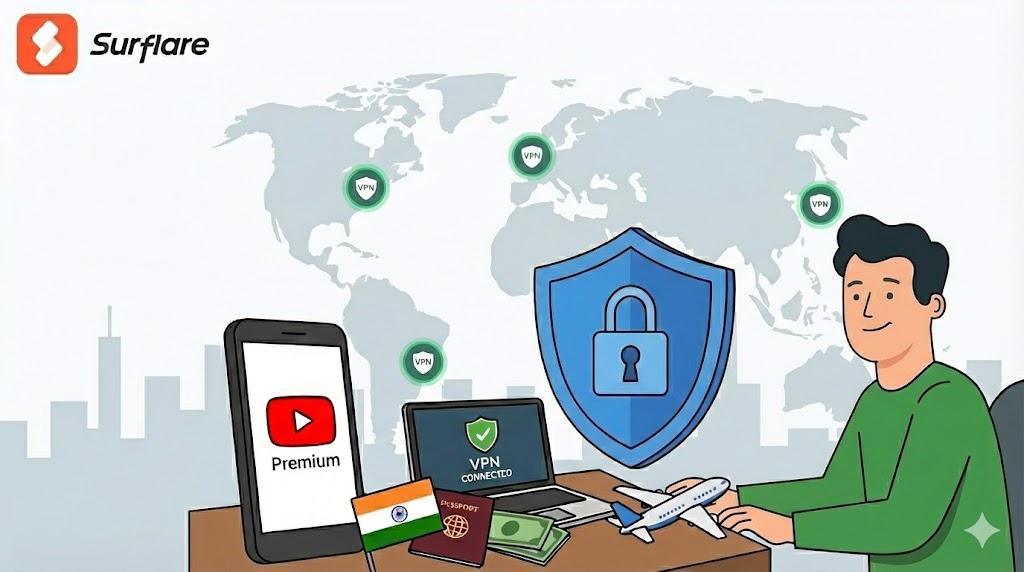
If you have been using YouTube recently, especially the heavily discussed "Indian region YouTube," you may have noticed some changes: even though your account has not changed and your device remains the same, you are more frequently asked to verify your security when logging in, and some users may even encounter their Premium subscription being paused or a direct prompt stating "abnormal activity detected."
Such situations are not isolated incidents. Recently, there has been a noticeable increase in feedback regarding abnormal YouTube accounts, YouTube account restrictions, and verification triggered by remote logins, leading more users to search for VPN recommendations in an attempt to understand whether the issue lies with the account itself or changes in the usage environment. For many long-term YouTube users, the confusion does not stem from "a single failed login," but rather: why has an account that was previously stable for a long time now become more easily flagged as abnormal by the system?
To understand this change, it is crucial to see the shift in the platform's judgment logic from a holistic perspective. This article will focus on the following three core questions:
- First, why has the situation of "abnormal YouTube accounts" increased significantly recently, and is there a common logic behind this change;
- Second, what risk signals are currently prioritized by Google / YouTube in account risk control, and what role does "remote login" play in the overall judgment;
- Third, if users simply wish to use YouTube and Google services long-term and stably, how can they reduce the uncertainties brought by the network environment to minimize unnecessary verifications and interruptions in usage.
1. Why has the "abnormal Indian region YouTube account" situation significantly increased recently?
If you have been using Indian region YouTube recently, you may repeatedly encounter similar situations:
- More frequent security verifications during login: SMS, email, device confirmations, or even repeated requests for secondary verification;
- Premium subscription being paused or requiring reconfirmation: the system prompts that payment confirmation or region re-verification is needed;
- Prompt "abnormal activity detected": this does not necessarily mean "account theft," but is more of a risk alert.
These phenomena appearing in a short time are not coincidental. A clear change is that YouTube's criteria for assessing account security are shifting towards "long-term consistency." The platform is no longer just concerned with where a single login comes from, but is beginning to comprehensively evaluate the account's usage trajectory over a period of time, including whether the login region has been consistently the same, whether the network exit frequently changes, and whether the overall usage behavior is stable.
Therefore, the so-called remote login detection is not just about determining the country of the IP, but rather a multi-dimensional risk assessment mechanism. When network exits, usage regions, account history, device fingerprints, login frequency, and subscription and payment factors are all taken into account, any significant inconsistency in even a few of these aspects can more easily trigger additional identity verification processes.
This also explains why some users, even when continuously using the same VPN or without changing devices and accounts, still frequently receive risk control prompts. The issue does not lie in a single factor failing, but rather in the platform's requirements for "composite signals" becoming stricter; account stability depends on whether multiple variables remain consistent over a period of time.
In this context, many people, when encountering verification or subscription restrictions, often suspect abnormal YouTube accounts or YouTube account restrictions. However, based on recent usage feedback, the more common situation is that the account itself has not undergone substantial changes; the real change is in the platform's assessment method of the stability of the usage environment.
This trend is particularly evident in the context of abnormal Indian region YouTube accounts. Due to the higher sensitivity of subscriptions and regional attributes in the Indian region, when the actual usage environment is inconsistent with the account's region, combined with frequent changes in network exits, it becomes easier for the system to identify this as a high-risk usage pattern. This is also why discussions about abnormal YouTube accounts and YouTube account risk control have been heating up recently, gradually focusing on the core issue of "whether the network environment is stable."
2. What login risk signals does Google / YouTube currently focus on?
In the context of frequent "abnormal Indian region YouTube accounts," many discussions tend to focus on a single factor, such as VPN, IP, device, or payment method. However, from an overall judgment logic perspective, YouTube's account risk control is not triggered by a single condition, but rather assesses the risk level of the account through the accumulation of multiple signals.
1) Is the login region consistently stable over the long term: the platform is beginning to look at "trajectories," not just "moments"
In the current risk control system, one of the core judgment dimensions is whether the login region of the account shows stability. The platform no longer only focuses on "where this login comes from," but observes the regional usage trajectory of the account over a period of time.
If the login region of the account frequently changes or spans multiple countries and regions in a short time, even if each login itself is successful, it is more likely to be determined by the system as needing further identity confirmation. This is particularly evident in the remote login scenario: the issue is not "whether it is remote," but rather "whether it is frequent and lacks continuity."
2) Is the network environment "clean": the more crowded the shared exit, the more likely it is to be seen as an abnormal source
In addition to regional information, the stability of the network exit is also an important signal. "Clean" does not refer to any "violations," but rather:
- Is this IP segment being repeatedly used by a large number of accounts;
- Does this exit frequently exhibit abnormal logins, batch behaviors, or suspicious requests;
- Is this node often flagged by the platform, required to enter verification codes, or even restricted.
The platform will pay attention to whether the network used by the account frequently changes exit IPs and whether these IPs belong to shared resources used by a large number of accounts. When an account consistently uses highly shared and frequently changing network exits, even if the account's behavior itself is relatively normal, it is more likely to be classified as a high-risk source. This is also one reason why some users encounter verification prompts more easily when using free VPNs, low-quality proxies, or unknown "shared airports." You may think you are just "borrowing the network," but the platform sees it as "an exit crowded with many unfamiliar accounts." When this exit is combined with your account's regional attributes and subscription attributes, it becomes easier to trigger risk control.
3) Does the account's historical behavior align with the current usage pattern
YouTube will also compare the current login behavior with the historical usage characteristics of the account. For example, if the account has primarily been used in a certain region or network environment in the past, and suddenly shows a significantly different login pattern, it may trigger additional security checks.
This judgment does not target a single operation, but is based on "whether there is consistency." Once the system believes that the current usage pattern deviates significantly from the account's historical profile, it is more likely to require identity confirmation again.
4) Are there any conflicts in subscription and payment-related factors
When it comes to paid services like YouTube Premium, account risk control is usually stricter. The attention on Indian region YouTube is due to the higher likelihood of inconsistencies between the subscription region, payment information, and the actual usage environment.
When the system determines that the actual usage environment of the account has not been in India for a long time, or that there is a lack of stable correspondence between the subscription region, payment factors, and usage behavior, it may trigger reconfirmation, subscription suspension, or additional verification. This type of judgment is not based on a single operation but is completed through continuous observation of the subscription and usage trajectory.
The platform will comprehensively reference the degree of matching between the subscription region, payment information, and actual usage environment. Once these factors repeatedly show deviations over a period of time, the account is more likely to be categorized as needing focused confirmation.
For accounts related to Indian region YouTube, this dimension is more sensitive. Therefore, the increase in verifications is often not targeted at individuals, but rather because the current combination of network and behavior is deemed high risk by the system.
Summary: Risk control is not about "blocking a specific point," but about judging "whether the overall situation is reasonable"
In summary, Google / YouTube's account risk control is not triggered by a single condition, but rather assesses account stability through the accumulation of multiple signals. When the login region, network exit, account history, and subscription-related factors lack consistency over a period of time, even if the account itself has no abnormal operations, it is more likely to be required by the system to undergo additional verification.
This also explains why discussions about YouTube account risk control, remote logins, and VPN recommendations have been increasing recently: as the judgment logic becomes more refined, the impact of the network environment on the overall user experience is being intuitively felt by more and more users.
3. Why is the search volume for "VPN recommendations" continuously rising? What is truly needed is not "changing nodes"
As more users realize that account abnormalities are not triggered by a single factor, the focus naturally shifts from "the account itself" to "the usage environment." This is also the direct background for the continuous rise in search volume for VPN recommendations among users in the Chinese-speaking region, especially in mainland China.
However, it is important to clarify that most users search for VPNs not to frequently switch regions or try various tricks, but to stabilize the overall usage environment of their YouTube account, thereby reducing the repeated verification prompts and interruptions in usage. In reality, many users are already using VPNs but still frequently trigger risk controls, and even when neither the device nor the account has changed, the number of verifications has increased.
This does not mean that VPNs have "failed," but rather that the usage method does not align with the platform's current judgment logic. From YouTube's risk control perspective, the key is not whether a VPN is used, but whether the network environment has long-term consistency. When nodes frequently change, exit IPs are highly shared, or there are frequent cross-regional switches during use, such network behavior is more easily recognized by the system as a high-risk source.
For this reason, a simple "VPN recommendation" does not truly solve the problem. For users who have been using YouTube or Google services for a long time, what is more important is not "whether they can connect," but whether the network environment is relatively fixed, whether the usage trajectory is continuous, and whether the overall behavior shows stable characteristics.
When the usage goal shifts from "passing a verification once in the short term" to "stable long-term use," the judgment criteria often converge on three core keywords: consistency, controllability, sustainability.
-
Consistency: Network exits, devices used, and login habits remain relatively stable, avoiding frequent cross-regional switches;
-
Controllability: Node quality, latency, peak performance, and disconnection rates are predictable, rather than relying entirely on luck;
-
Sustainability: The network environment used can be maintained long-term, rather than frequently changing tools, nodes, or configurations.
It is based on this shift that "VPN recommendations" have gained traction. The focus of users has shifted from "cheap temporary solutions to connectivity issues" to how to reduce uncertainties in long-term usage.
4. Why do free VPNs encounter more problems? The core issue is not "free," but "unstable"
In the context of increasingly refined account risk control, many abnormal experiences ultimately point to the same factor: the randomness of the network environment. This is why many users encounter login verifications, subscription interruptions, or abnormal prompts when using free VPNs.
From the platform's perspective, free VPNs often have several inherent risk characteristics.
- First, there is a high IP reuse rate. The same network exit being used simultaneously by a large number of unfamiliar accounts significantly increases the overall risk score, making it more likely for even a normal account's behavior to get caught up in verification processes.
- Secondly, nodes and exits frequently change. Free services usually struggle to maintain a stable pool of nodes, resulting in users' network trajectories showing significant jumps.
- Moreover, network quality is uncontrollable. High latency, packet loss, jitter, and congestion during peak hours can all make login and request behaviors appear unstable.
More realistically, the maintenance costs of free tools need to be passed on: either through extremely crowded shared resources or through monetization via ads/data. For you, this means that "stability" and "controllability" are hard to achieve.
From "usable VPN" to "stable VPN": the demand is changing
As the root of the problem becomes clearer, user demand is also shifting. For those who use YouTube or Google services long-term, what is truly needed is not "more node options," but a network environment that is closer to long-term normal usage.
This is precisely why "stable VPNs" are gradually gaining attention. Stability does not mean promising to avoid verification, but emphasizes the following aspects: network exits are relatively fixed, usage trajectories are continuous; node quality and connection performance are predictable; overall usage behavior is easier to maintain consistency. It does not solve "passing verification once," but rather reducing uncertainties in long-term usage.
With the trend of YouTube's risk control becoming increasingly detailed, the network environment has shifted from being an "auxiliary tool" to a key variable affecting account experience. Rather than repeatedly switching in an unstable environment, it is better to control this variable early on to keep the account's usage status as stable as possible.
This is also why more and more users are beginning to focus on stability, controllability, and long-term experience when searching for VPN recommendations—because only when the network environment is sufficiently consistent can the normal usage value of the account itself truly be preserved.
5. Rationally view the relationship between VPN and YouTube accounts: it is not a "universal key," but can reduce unnecessary variables
After discussing the logic of account risk control, the impact of the network environment, and the misconceptions about VPN usage, one premise needs to be clarified: VPN is not a universal key that solves all problems. No tool can guarantee that an account will never trigger verification, nor can it replace the platform's own security rules.
What truly affects the account usage experience is not "what tools are used," but rather whether long-term behavior shows consistency.
From a practical perspective, the long-term consistency that affects account stability mainly includes three types of variables:
- Network: Is the exit stable, does it frequently cross regions, is it overly shared;
- Device: Is the device/browser frequently changed, is the environment frequently cleared leading to "like a new device";
- Usage habits: Is there frequent switching of regions within a short time, repeated logins, or attempts under abnormal network conditions.
Therefore, the role of VPNs here is not to "bypass the rules," but to reduce the uncertainties brought by the network variable. Choosing the right VPN essentially stabilizes and controls the "network variable," making the user's usage environment more like that of a "long-term stable normal user," and avoiding triggering high-risk signals as much as possible.
6. Summary: Platform rules are changing, and stability is becoming long-term value
Returning to the initial question: why has there been a noticeable increase in abnormal Indian region YouTube accounts recently? Why has VPN recommendations become a high-frequency search term? Ultimately, it is because the platform's requirements for the account usage environment are increasing, and stability is shifting from "experience optimization" to "long-term value."
In the context of YouTube's risk control becoming gradually refined, whether an account is stable increasingly depends on whether multiple variables remain consistent over a period of time. Among these, the network environment is the most easily overlooked yet has the most direct impact.
For users who wish to use YouTube and Google services long-term and stably, rather than repeatedly dealing with verifications in an unstable environment, it is better to control the network as a fundamental condition from the start, reducing unnecessary fluctuations and disturbances. This is not about pursuing "avoidance," but about returning the usage experience to a more predictable and sustainable state.
It is also under this trend that stable VPNs are gradually becoming an option that more users are seriously considering—what they focus on is not short-term effects, but consistency and controllability in long-term usage.
If you care about long-term experience rather than a one-time solution, treating the network environment as infrastructure to choose from is often a more worry-free and sustainable approach.
Frequently Asked Questions (FAQ)
Q1: Is an abnormal Indian region YouTube account necessarily banned?
Not necessarily. In most cases, it is the system detecting frequent changes in the login environment or risk signals, thus requiring additional verification, which does not equate to the account being banned.
Q2: Does using a VPN necessarily trigger YouTube's risk control?
No. The key is not whether a VPN is used, but whether the network environment is stable, whether the exit frequently changes, and whether it comes from high-risk shared nodes.
Q3: Why do free VPNs more easily lead to abnormal YouTube accounts?
Because free VPNs have high IP reuse rates, unstable nodes, and a higher historical risk for exits, making them more likely to be flagged by the platform as abnormal sources.
Q4: Can stable VPNs completely avoid verification?
No. No tool can guarantee that platform verification will never be triggered, but stable VPNs can help reduce unnecessary abnormal signals and improve long-term usage stability.
Next Steps: Stabilize the "network variable"
If you wish to use YouTube, Google login, and related services more stably, you can start with a more controllable and stable network solution.
Click to learn about Surflare VPN (suitable for long-term stable use)